

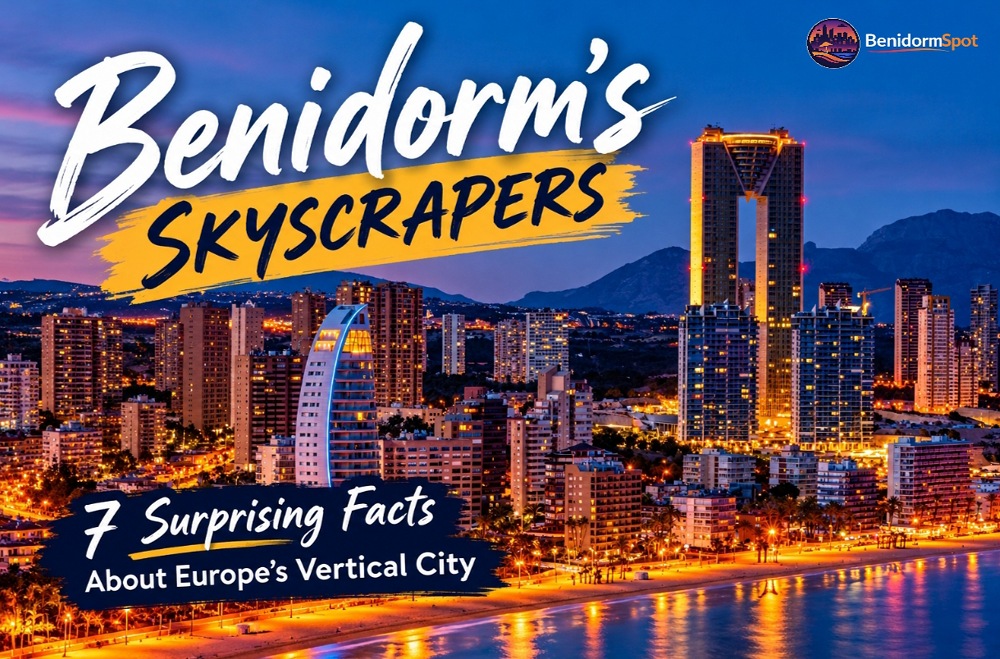
Benidorm is famous for its golden beaches, lively nightlife and seemingly endless rows of high-rise buildings. Look towards the skyline from Levante Beach or Poniente Beach, and you might think you are looking at a much larger city than a Mediterranean resort.
But just how many tall buildings does Benidorm actually have? How high do its tallest towers reach? And what happens when you compare the number of skyscrapers with the number of people who live in the city?
The answers reveal why this Costa Blanca destination has become one of Spain’s most distinctive urban landscapes.
Here are seven surprising facts about Benidorm’s skyscrapers that explain what makes its skyline so unusual.
1. How Many Skyscrapers Does Benidorm Really Have?
The answer depends on what you consider a skyscraper.
In October 2026, Benidorm’s municipal authorities presented the Los Rascacielos de Benidorm project, documenting 94 buildings taller than 80 metres. The project includes a 112-page book with more than 250 photographs and a digital platform dedicated to the city’s high-rise architecture.
According to the same municipal announcement, nearly 40 of the buildings exceed 100 metres in height.
An independent source, BeniSky, maintains its own detailed inventory, distinguishing completed buildings from towers still under construction. Its figures can differ from the municipal project because the inventories do not necessarily count exactly the same buildings or construction statuses.
That distinction matters. A building that has reached its planned height is not necessarily finished, and an announced project is not the same as an existing skyscraper.
For a meaningful comparison, it is useful to look at specific height thresholds:
- 80 metres and above: the broad category used by the municipal skyscraper project.
- 100 metres and above: a more selective category that captures Benidorm’s most prominent high-rise buildings.
- 150 metres and above: a useful benchmark for comparing the city with other major skyscraper destinations.
According to the building inventory and comparisons compiled by BeniSky, 33 completed buildings exceed 100 metres, while three buildings meet the Council on Vertical Urbanism’s 150-metre threshold. Some other lists count four, depending on their inclusion criteria and the reported height of Sunset Sailors Tower 1.
There is no single number that tells the whole story. The threshold, completion status and source all matter.
Sources: Benidorm City Council and BeniSky.
2. One Tall Building for Every 950 Residents?
Here is a statistic that puts Benidorm’s skyline into perspective.
Spain’s National Statistics Institute (INE) recorded 77,327 residents in Benidorm in 2025. That is the official resident population, not the number of people staying in the city during the tourist season.
Using BeniSky’s count of 81 completed buildings at least 80 metres tall, the calculation is straightforward:
77,327 residents ÷ 81 buildings = approximately 955 residents per building.
In other words, there is roughly one completed building of at least 80 metres for every 955 permanent residents.
Using the separate threshold of 100 metres, the calculation becomes:
77,327 residents ÷ 33 buildings = approximately 2,343 residents per building.
These are statistical comparisons, not estimates of how many people live in each tower. Some buildings are hotels, others contain private apartments, and many visitors stay in the city temporarily.
There is another important consideration: Benidorm’s permanent population is only part of the picture. Tourists, seasonal residents and other visitors increase the number of people using the city, particularly during busy periods.
That is one reason why the skyline looks so extraordinary compared with the size of the permanent population.
Does this make Benidorm the city with the most skyscrapers per inhabitant in the world? Not necessarily. That claim is often repeated, but the result depends on the definition of a skyscraper, the population used and which cities are included in the comparison.
A more defensible conclusion is that Benidorm has an unusually high concentration of tall buildings relative to its permanent population.
Source: INE population statistics and BeniSky’s records and comparisons.
3. InTempo: The Tower That Defines Benidorm’s Skyline
If one building represents modern Benidorm, it is difficult to overlook InTempo.
Standing 187.1 metres tall, the residential tower is recognised by the Council on Vertical Urbanism’s Skyscraper Center as the tallest residential building in Spain.
Completed in 2021, InTempo has 49 floors above ground and 256 apartments. Its distinctive design features two tall sections connected visually by a large, diamond-shaped structure near the top.
The building is located in the Poniente area, where modern residential developments have transformed the coastal skyline.
InTempo is particularly striking because it combines a monumental height with a residential purpose. It is not simply an observation tower or an office building: it contains homes high above the Mediterranean coast.
Its construction also illustrates a broader aspect of high-rise development. Buildings of this scale involve complex engineering, construction logistics, financing and years of planning.
For visitors, however, the immediate impression is much simpler: it is one of the most recognisable silhouettes on the Benidorm skyline.
One detail worth remembering is that the title of Spain’s tallest building depends on the category being compared. InTempo holds the residential-building distinction, but that does not mean it is the tallest structure of every type in the country.
Source: The Skyscraper Center — InTempo.
4. Gran Hotel Bali: A Giant Built for Visitors
Another landmark is Gran Hotel Bali, which stands approximately 186 metres tall and has 52 floors.
Completed in 2002, it became one of the defining examples of Benidorm’s high-rise hotel architecture. For years, it was particularly famous for its height and its prominent position near Poniente Beach.
Unlike InTempo, which is primarily residential, Gran Hotel Bali was designed as a hotel. Its scale reflects the role that tourism has played in shaping Benidorm’s built environment.
The distinction between residential towers and hotels is important when looking at the city’s skyline. Two buildings of similar height can serve very different purposes, accommodate different numbers of people and operate in completely different ways.
Gran Hotel Bali also became known for its tower-running events, in which participants race up the building’s stairs. Such competitions turn a building’s vertical scale into a sporting challenge rather than simply an architectural feature.
For visitors, the hotel is a useful reminder that Benidorm’s high-rise landscape is not exclusively residential. Tourism itself has helped create the city’s most recognisable buildings.
Source: The Skyscraper Center — Gran Hotel Bali.
5. Why Did Benidorm Build Up Instead of Out?
Benidorm’s skyline did not happen by accident.
The city’s modern high-rise development was shaped by its planning decisions, its coastal location and the growing demand for tourist accommodation.
A key milestone was the urban development plan introduced in 1956 and amended in 1963. The planning approach allowed tall buildings on relatively small plots, with open space around them.
Instead of spreading hotels and apartment blocks continuously across the landscape, this approach made it possible to accommodate substantial numbers of visitors in vertical buildings.
There are several practical advantages to this model.
First, the coastline is a limited resource. Benidorm cannot keep extending its beachfront indefinitely, so building upwards allows more accommodation to be provided within a relatively compact urban area.
Second, high-rise development can leave more space around buildings for streets, gardens, communal areas and pedestrian routes than a continuous pattern of low-rise construction might allow. The actual result depends on the design and layout of each development.
Third, concentrated accommodation helps support a destination built around beaches, restaurants, shops and entertainment. Many visitors can stay within reach of the same urban infrastructure.
That does not mean every high-rise development is automatically more sustainable or better designed. Tall buildings require substantial construction materials, energy, lifts, maintenance and careful planning. Their impact depends on how they are built and used.
Nevertheless, Benidorm demonstrates how a tourist destination can develop a very different urban identity from the low-rise coastal towns that surround it.
Its skyline is not merely a collection of tall buildings. It is the visible result of a particular approach to tourism and urban planning.
6. The 2000s Were a Major Decade for Benidorm’s Skyline
Benidorm’s high-rise development accelerated dramatically around the turn of the millennium.
BeniSky’s inventory identifies 41 completed buildings of at least 80 metres that were finished between 2000 and 2009.
That is a remarkable concentration of construction within a single decade.
The year 2002 stands out in the same dataset, with 11 towers of at least 80 metres completed. It was also the year Gran Hotel Bali reached completion.
The figures show that Benidorm’s vertical identity did not emerge entirely in the early years of mass tourism. A substantial part of the skyline familiar to visitors today took shape much later.
The following years brought further projects, including residential towers and newer developments around Poniente Beach.
The skyline continues to evolve. In 2026, the municipal skyscraper project documented dozens of buildings over 80 metres, while BeniSky’s inventory included towers under construction.
One particularly ambitious project is TM Tower, planned to reach 230 metres, with completion announced for 2028. If delivered at the planned height, it would significantly change the skyline and become taller than both InTempo and Gran Hotel Bali.
However, a planned height and completion date should not be confused with an existing building record. Until construction is complete, the project remains part of Benidorm’s future skyline.
Source: BeniSky — All Skyscrapers.
7. Is Benidorm Really Europe’s Manhattan?
Benidorm is often compared with Manhattan because of its dense concentration of tall buildings beside the sea.
The nickname is easy to understand. The skyline is unusually prominent for a Mediterranean resort, and the contrast between beaches, mountains and high-rise towers gives the city a distinctive appearance.
But comparisons with New York need some context.
Manhattan is part of a much larger metropolitan area and has a different economic structure, urban history and population. Benidorm is a smaller coastal city whose high-rise landscape is closely connected to tourism and residential accommodation.
The comparison becomes more interesting when individual measures are used.
For example, BeniSky’s analysis indicates that Benidorm has 33 buildings over 100 metres for a permanent population of 77,327. That is approximately 42.7 buildings per 100,000 residents.
At the 150-metre threshold, however, the comparison changes. BeniSky notes that Hong Kong and Dubai have more very tall buildings per resident under its comparison, while Benidorm has a higher count per resident than New York City under the same threshold.
These figures illustrate why broad claims about the world’s most vertical city need careful definitions. A city can rank highly by one measure and lower by another.
What is beyond dispute is that Benidorm has developed a remarkably vertical skyline for a city of its size.
And unlike many skyscraper districts, its towers stand directly alongside Mediterranean beaches, giving visitors a view that is difficult to confuse with anywhere else.
Where Can You Get the Best Views of Benidorm’s Skyline?
You do not need to enter a skyscraper to appreciate Benidorm’s architecture. In fact, some of the best views come from outside the city centre.
Levante Beach
Levante Beach offers a classic view of Benidorm’s skyline, with high-rise hotels and apartment buildings rising behind the promenade. It is an excellent place for photographs, particularly when the light is softer in the morning or late afternoon.
Poniente Beach
Poniente provides a different perspective, with modern residential towers and landmarks such as InTempo and Gran Hotel Bali. It is especially interesting for anyone who wants to see the newer side of Benidorm’s development.
La Cruz de Benidorm
For a higher viewpoint, the area around La Cruz de Benidorm offers panoramic views across the city, the beaches and the Mediterranean Sea. The walk can involve uneven or steep sections, so suitable footwear is advisable.
The seafront promenade
Walking along the promenades is one of the simplest ways to appreciate the scale of the buildings. As you move along the coast, the relationship between the towers, beaches and surrounding mountains changes constantly.
For photography, try comparing the skyline from different parts of the coast rather than taking every picture from the same location.
Final Thoughts: A Small City With a Remarkable Skyline
Benidorm’s skyscrapers are more than an architectural curiosity. They reveal how tourism, urban planning and limited coastal space have shaped one of Spain’s best-known holiday destinations.
The numbers are impressive: the municipal skyscraper project documents 94 buildings above 80 metres, InTempo rises 187.1 metres above the city, and dozens of completed towers exceed 100 metres.
The comparison with the permanent population is equally striking, although it needs to be interpreted carefully because the city accommodates many visitors who are not counted as residents.
Benidorm’s skyline will also continue to change. With new projects planned, the next few years may bring another chapter in the development of this vertical Mediterranean city.
Whether you admire the architecture or prefer the traditional charm of Spain’s smaller coastal towns, one thing is clear: Benidorm is not just a beach destination. It is also one of the most distinctive urban landscapes on the Costa Blanca.
Have you ever wondered how many skyscrapers Benidorm has, or which tower is the tallest? Share this article with someone who loves discovering the surprising facts behind popular holiday destinations.




Leave a Reply